A. COBRA

Planet Earth is gifted with approximately 2000 species of snakes, out of which 272 are present in India ranging from the 10 cm long worm snake to the 7 meter long python and king cobra. India is blessed with three species of cobras, mainly the Indian Spectacled Cobra (Naja naja naja), the mono-ocellate cobra (Naja naja kaouthia) and the black cobra. Six species are present in Asia and nine in Africa.
1. Spectacled Cobra


The monocled cobra (Naja kaouthia) is a cobra species, which is widespread across central and southern Asia. The monocled cobra has an O-shaped, or monocellate hood pattern, unlike that of the Indian cobra. Coloration in young is more constant. They are olivaceous or brownish to black above with or without a yellow or orange-coloured O-shaped mark upon the hood. They have a black spot on the lower surface of the hood on either side, and one or two black cross-bars on the belly behind it.
The rest of the belly is usually of the same colour as the back, but paler. As age advances, they become paler, and when adult are brownish or olivaceous. Adult monocled cobras reach a length of 135 to 150 cm (53 to 59 in) with a tail length of 23 cm (9.1 in). Many larger specimens have been recorded, but they are rare. They have 25 to 31 scales on the neck, 19 to 21, usually 21, on the body, and 17 or 15 on the front of the vent. They have 164 to 196 Ventral scales and 43 to 58 subcaudal scales.
3. Black Cobra


The king cobra (Ophiophagus hannah) is the world's longest venomous snake, with a length up to 5.6 m (18.5 ft). This species, which preys chiefly on other snakes, is found predominantly in forests from India through Southeast Asia to the Philippines and Indonesia. Despite the word "cobra" in its name, this snake is not a member of Naja ("true cobras") but belongs to its own genus.
The king cobra is the sole member of genus Ophiophagus, while most other cobras are members of the genus Naja. They can be distinguished from other cobras by size and hood marks. King cobras are generally larger than other cobras, and the stripe on the neck is like the symbol "^" instead of a double or single eye shape(s) that may be seen in most of the other Asian cobras. A foolproof method of identification is if on the head, clearly visible, is the presence of a pair of large scales known as occipitals, at the back of the top of the head. These are behind the usual "nine-plate" arrangement typical of colubrids and elapids, and are unique to the king cobra.
The king cobra averages at 3 to 4 meters (9.8 to 13 ft) in length and typically weighing about 6 kilograms (13 lb). The longest known specimen was kept captive at the London Zoo, and grew to around 18.5 to 18.8 feet (5.6 to 5.7 m)...The skin of this snake is either olive-green, tan, or black, and it has faint, pale yellow cross bands down the length of the body. The belly is cream or pale yellow, and the scales are smooth. Juveniles are shiny black with narrow yellow bands (can be mistaken for a banded krait, but readily identified with its expandable hood). The head of a mature snake can be quite massive and bulky in appearance, though like all snakes, they can expand their jaws to swallow large prey items.
B. VIPER

The Viper are a family of venomous snakes found all over the world, except in Antarctica, Australia, Ireland, Madagascar, Hawaii, various other isolated islands, and above the Arctic Circle. All have relatively long, hinged fangs that permit deep penetration and injection of venom. Four subfamilies are currently recognized. They are commonly known as vipers or viperids.
Almost all vipers have keeled scales, a stocky build with a short tail, and, due to the location of the venom glands, a triangular-shaped head distinct from the neck. The great majority have vertically elliptical, or slit-shaped, pupils that can open wide to cover most of the eye or close almost completely, which helps them to see in a wide range of light levels.


The color-pattern consists of a pale buff, grayish, reddish, olive or pale brown ground color, overlaid middorsally with a series of variably colored, but mostly whitish spots, edged with dark brown, and separated by lighter interblotch patches. A series of white bows run dorsolaterally. The top of the head has a whitish cruciform or trident pattern and there is a faint stripe running from the eye to the angle of the jaw. The belly is whitish to pinkish, uniform in color or with brown dots that are either faint or distinct.
2. Russell's Viper


Daboia is a monotypic genus of venomous Old World viper. The single species, D. russelii, is found in Asia throughout the Indian subcontinent, much of Southeast Asia, southern China and Taiwan. The species was named in honor of Patrick Russell (1726–1805), aScottish herpetologist who first described many of India's snakes; and the genus is after the Hindi name meaning "that lies hid", or "the lurker."[9] Apart from being a member of the big four snakes in India, Daboia is also one of the species responsible for causing the mostsnakebite incidents and deaths among all venomous snakes on account of many factors,such as their wide distribution and frequent occurrence in highly-populated areas.
The head is flattened, triangular and distinct from the neck. The snout is blunt, rounded and raised. The nostrils are large, in the middle of a large, single nasal scale. The lower edge of the nasal touches the nasorostral. The supranasal has a strong crescent shape and separates the nasal from the nasorostral anteriorly.
 3. GREEN PIT VIPER

Trimeresurus is a genus of venomous pitvipers found in Asia from Pakistan, through India, China, throughout Southeast Asia and the Pacific Islands. Currently 35 species are recognized. Common names include Asian pit vipers, Asian lanceheads and Asian lance-headed vipers.
An endemic pit viper with its characteristic green colouration and triangular head. Its green coat is camouflaged by yellow mottles outlined by black. Its camouflage often allows it to go unnoticed even to a trained eye until it gives itself away by moving. It has an extremely prehensile tail which proves vital for it s arboreal nature.
C. KRAIT-


The common krait (Bungarus caeruleus, also known as Indian krait or Blue krait) is a species of genus Bungarus found in the jungles of theIndian subcontinent.[1] It is a member of the "big four", species inflicting the most snakebites in India.
Behavioral differences during day and nighttime have been reported in Bungarus caeruleus. During the day it is sluggish and rolls its body into a loose coiled ball, keeping its head well-concealed. In balled condition, the snake allows considerable handling, however, over handling often instigates bites. At night the snake is very active, escapes by hissing loudly, or keeping still, occasionally biting the source of the annoyance.


Planet Earth is gifted with approximately 2000 species of snakes, out of which 272 are present in India ranging from the 10 cm long worm snake to the 7 meter long python and king cobra. India is blessed with three species of cobras, mainly the Indian Spectacled Cobra (Naja naja naja), the mono-ocellate cobra (Naja naja kaouthia) and the black cobra. Six species are present in Asia and nine in Africa.
1. Spectacled Cobra


Scientific name: Naja naja
Indian name: Hindi-Nag; Tamil-Nalla pamboo; Kannada-Nagara Haavu; Malayalam-Moorkan
Average Length: seven to eight feet.
Average Length at Birth: 25 cm.
Indian name: Hindi-Nag; Tamil-Nalla pamboo; Kannada-Nagara Haavu; Malayalam-Moorkan
Average Length: seven to eight feet.
Average Length at Birth: 25 cm.
DISTRIBUTION: The spectacled cobra is widely distributed across the length and breadth of the country from sea level up to 4000 m (in the Himalayas). The colour varies from black or dark brown to yellowish white. The famous spectacled markings are but a pair of connected rings. In some cobras, the spectacled markings are altogether absent. The cobras of North West India are more blackish in colour and have barely distinguishable spectacled markings.
2. Monocellate Cobra

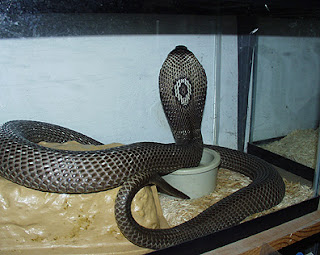
The monocled cobra (Naja kaouthia) is a cobra species, which is widespread across central and southern Asia. The monocled cobra has an O-shaped, or monocellate hood pattern, unlike that of the Indian cobra. Coloration in young is more constant. They are olivaceous or brownish to black above with or without a yellow or orange-coloured O-shaped mark upon the hood. They have a black spot on the lower surface of the hood on either side, and one or two black cross-bars on the belly behind it.
3. Black Cobra


- Black cobras are known by many names such as the Pakistan black cobra, the Indian cobra or simply, the common cobra. Dr. Wolfgang Wuster, a herpetologist with the University of Wales, has noted in his research on Asiatic cobras that there has been some confusion and uncertainty within the scientific community regarding the taxonomy of some cobra species. Currently, the black cobra is classified as belonging to the genus Naja (which includes all pure cobras). Most often, however, black cobras (Naja naja) are called Indian cobras or spectacled cobras by common name.
Appearance, Size and Reproduction
- Naja naja is variable in its appearance. The color of the black cobra's scales can be tan, black or speckled. Regardless of their dominant color, black cobras usually have a distinct ring-shaped marking on their neck. This symbolic marking serves as a warning when the neck is flattened in its defensive posture. The species varies in size from 3 to 6 feet on average, but can occasionally grow larger. Like all cobras, theses snakes lay eggs, but the mothers often accompany and protect the eggs during their incubation periods, which last about 50 to 60 days, an atypical behavioral trait for snakes.


The king cobra (Ophiophagus hannah) is the world's longest venomous snake, with a length up to 5.6 m (18.5 ft). This species, which preys chiefly on other snakes, is found predominantly in forests from India through Southeast Asia to the Philippines and Indonesia. Despite the word "cobra" in its name, this snake is not a member of Naja ("true cobras") but belongs to its own genus.
B. VIPER

The Viper are a family of venomous snakes found all over the world, except in Antarctica, Australia, Ireland, Madagascar, Hawaii, various other isolated islands, and above the Arctic Circle. All have relatively long, hinged fangs that permit deep penetration and injection of venom. Four subfamilies are currently recognized. They are commonly known as vipers or viperids.
Almost all vipers have keeled scales, a stocky build with a short tail, and, due to the location of the venom glands, a triangular-shaped head distinct from the neck. The great majority have vertically elliptical, or slit-shaped, pupils that can open wide to cover most of the eye or close almost completely, which helps them to see in a wide range of light levels.
1). Saw Scaled Viper (echis carinatus) -


This snake is considered to be the world's most dangerous snake because of its highly virulent hematoxic venom, and its aggressive, easily excitable temperament. It is quick to strike and difficult to see, because of its camouflage coloration. They are abundant in many populated agricultural areas in India and South East Asia.
This snake is relatively small and averages between 12 and 24 inches. It produces a characteristic sound by coiling its body in parallel loops and rubbing the body sides together, producing a sharp sizzling sound. It moves quickly in a sidewinder fashion. A nocturnal hunter, it comes out in the early evening to hunt rodents, just as many agricultural workers are leaving the fields, barefoot, to walk home.
This snake is relatively small and averages between 12 and 24 inches. It produces a characteristic sound by coiling its body in parallel loops and rubbing the body sides together, producing a sharp sizzling sound. It moves quickly in a sidewinder fashion. A nocturnal hunter, it comes out in the early evening to hunt rodents, just as many agricultural workers are leaving the fields, barefoot, to walk home.
2. Russell's Viper

Daboia is a monotypic genus of venomous Old World viper. The single species, D. russelii, is found in Asia throughout the Indian subcontinent, much of Southeast Asia, southern China and Taiwan. The species was named in honor of Patrick Russell (1726–1805), aScottish herpetologist who first described many of India's snakes; and the genus is after the Hindi name meaning "that lies hid", or "the lurker."[9] Apart from being a member of the big four snakes in India, Daboia is also one of the species responsible for causing the mostsnakebite incidents and deaths among all venomous snakes on account of many factors,such as their wide distribution and frequent occurrence in highly-populated areas.
This snake can grow to a maximum length of 166 cm (5.5 ft) and averages about 120 cm (4 ft) on mainland Asian populations, although island populations do not attain this size. It is more slenderly built than most other vipers. Ditmars (1937) reported the following dimensions for a "fair sized adult specimen":
| Total length | 4 ft., 1 inch | 124 cm |
| Length of tail | 7 inches | 18 cm |
| Girth | 6 inches | 15 cm |
| Width of head | 2 inches | 5 cm |
| Length of head | 2 inches | 5 cm |
The head is flattened, triangular and distinct from the neck. The snout is blunt, rounded and raised. The nostrils are large, in the middle of a large, single nasal scale. The lower edge of the nasal touches the nasorostral. The supranasal has a strong crescent shape and separates the nasal from the nasorostral anteriorly.
 3. GREEN PIT VIPER
Trimeresurus is a genus of venomous pitvipers found in Asia from Pakistan, through India, China, throughout Southeast Asia and the Pacific Islands. Currently 35 species are recognized. Common names include Asian pit vipers, Asian lanceheads and Asian lance-headed vipers.
An endemic pit viper with its characteristic green colouration and triangular head. Its green coat is camouflaged by yellow mottles outlined by black. Its camouflage often allows it to go unnoticed even to a trained eye until it gives itself away by moving. It has an extremely prehensile tail which proves vital for it s arboreal nature.
Behaviour: Highly active by day and may adapt a nocturnal lifestyle if the conditions determine so. Due to its effective camouflage it is seldom roused by human contact. If it by chance gets discovered it usually makes every attempt to escape and avoid confrontation. However if cornered or handled may get roused and strike.
C. KRAIT-


The common krait (Bungarus caeruleus, also known as Indian krait or Blue krait) is a species of genus Bungarus found in the jungles of theIndian subcontinent.[1] It is a member of the "big four", species inflicting the most snakebites in India.
The body colour varies from a dark steely blue-black to a pale faded bluish grey. The average length is 0.9 meters (2 ft 11 in) but they can grow to 1.75 meters (5 ft 9 in).[1] Subcaudal scales after the anal plate are not divided. It has large hexagonal scales running down its spine. The narrow white cross bands are more prominent near the tail region.
The male is larger than the female and also has a longer tail.
Behavioral differences during day and nighttime have been reported in Bungarus caeruleus. During the day it is sluggish and rolls its body into a loose coiled ball, keeping its head well-concealed. In balled condition, the snake allows considerable handling, however, over handling often instigates bites. At night the snake is very active, escapes by hissing loudly, or keeping still, occasionally biting the source of the annoyance.


